
On Veterans Day, Centralia Remembers The Parade That Turned Into A Gunfight
CENTRALIA, WA — Every year on November 11, small towns across America line their streets with flags, put on uniforms that don’t quite fit like they used to, and remember the end of World War I.
Centralia does that too.
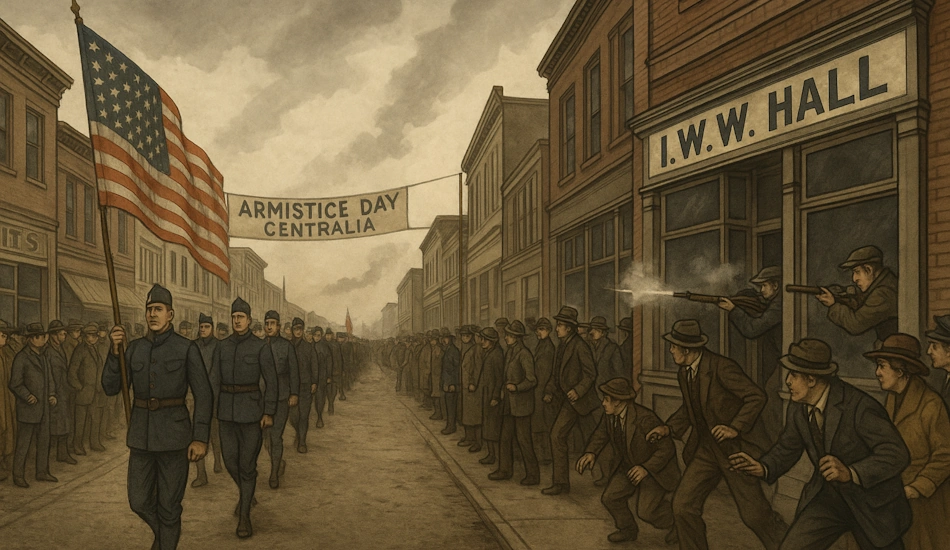
But here, Veterans Day is also the anniversary of something else: the 1919 Centralia Massacre, when a patriotic parade, a radical union hall, and months of simmering tension collided in a few bloody minutes on Tower Avenue.
No satire, no spin — just a hard story a town still doesn’t completely agree on.
A TIMBER TOWN LOADED LIKE KINDLING
In 1919, Centralia was a classic Northwest lumber town.
-
Sawmills and logging camps ran the local economy.
-
Many workers belonged to the Industrial Workers of the World (IWW), the “Wobblies,” a radical union that called for militant organizing and aggressive strikes.
-
Local business owners and officials saw the IWW as dangerous, disloyal, and possibly revolutionary.
The town had already boiled over once. In 1918, an earlier IWW hall was raided and wrecked by a mob. Union members were beaten and driven out of town. Nobody was held accountable.
So by the time November 1919 rolled around:
-
The IWW had a new hall downtown.
-
The American Legion, made up of returning WWI veterans, had formed a strong local post.
-
The country was in the middle of the First Red Scare, with newspapers warning daily about “Bolsheviks” and radicals.
Everyone was armed with something — rifles, anger, or both.
ARMISTICE DAY: A PARADE, A HALL, AND A BAD PLAN
November 11, 1919 was the first anniversary of the Armistice that ended World War I.
Centralia planned a big parade. The route took American Legionnaires marching right past the IWW hall on Tower Avenue — the same kind of setup that had ended in a raid the year before.
That decision — whether careless, deliberate, or somewhere in between — turned out to be deadly.
What happened next depends on who’s telling the story:
-
Legion / business version: The parade was just passing by. Wobblies opened fire first from inside their hall and from nearby positions, ambushing unarmed veterans.
-
IWW / labor version: The union had been warned of another planned raid. When some men from the parade broke ranks and rushed the hall, the Wobblies fired in self-defense to stop the mob from storming the building again.
The only thing everyone agrees on:
Within seconds, an Armistice Day parade turned into a street battle.
FOUR DEAD IN THE STREET, ONE HUNTED DOWN
Gunfire erupted from the IWW hall and from at least one hillside where union men had positioned lookouts.
When the smoke cleared:
-
Four American Legionnaires were dead or mortally wounded:
-
Warren Grimm
-
Arthur McElfresh
-
Ben Cassagranda
-
John Haney
-
Several others were injured.
On the union side, a logger and IWW member named Wesley Everest — himself a World War I veteran — tried to escape toward the river while firing back. He was chased, beaten, and eventually captured by a furious crowd.
The town was stunned. Word spread quickly that “radicals” had shot down war heroes on Armistice Day. In 1919 America, that was all many people needed to hear.
But the worst part of the day hadn’t even happened yet.
THE LYNCHING OF WESLEY EVEREST
That night, a mob took matters into its own hands.
Everest, badly beaten and in custody at the local jail, was dragged out by a group of men — widely believed to include Legionnaires and local citizens. He was marched to a bridge over the Chehalis River, hung, and shot.
No trial. No due process. No charges. Just street justice.
His body was left hanging, then later cut down.
To the IWW and many on the left, Everest became a martyr: a union man and veteran lynched for defending his hall. To many in Centralia at the time, he was simply the man who killed their friends and “got what he deserved.”
No one was ever convicted for his murder.
THE TRIAL THAT FOLLOWED THE RIOT
While Everest’s killers walked free, the state moved aggressively against the IWW.
Dozens of Wobblies were arrested. Eleven were put on trial in Montesano, charged with crimes ranging from conspiracy to murder.
The prosecution argued:
-
The IWW planned an ambush.
-
Hidden gunmen and fortified positions proved it was premeditated.
The defense argued:
-
The union had been attacked before.
-
They had every reason to expect another raid.
-
They fired only when their hall was rushed.
After a tense, nationally watched trial:
-
Seven IWW members were convicted of second-degree murder and given long prison sentences.
-
Others were convicted of lesser crimes or acquitted.
Again:
No one faced trial for the lynching of Wesley Everest.
The story fit perfectly into the national mood:
“Radicals kill veterans; brave citizens fight back.”
On the other side, labor activists told a different story:
“Workers defend themselves; the state punishes them and protects a lynch mob.”
Both narratives hardened, and both would live on for decades.
A TOWN WITH TWO MONUMENTS AND TWO MEMORIES
If you want to see how divided memory can be, you don’t have to read a history book. You can just walk through downtown Centralia.
In George Washington Park, right downtown, stands The Sentinel:
-
A bronze World War I soldier, rifle at his side.
-
Dedicated in 1924 to the four American Legionnaires who died.
-
For decades, it told the official story: veterans ambushed by radicals.
Decades later, just a short walk away, a large mural honoring the IWW was added to a downtown wall:
-
It remembers Wesley Everest and the Wobblies.
-
It tells the union side of the story: workers defending their hall.
More recently, a plaque naming IWW victims and prisoners was added near The Sentinel, creating something Centralia never really had before: a public space where both versions of the story show up in stone and paint.
You can stand there and literally see the argument — statue over here, mural over there.
THE QUESTIONS THIS ANNIVERSARY WON’T LET GO
More than a century has passed. Most of the buildings have changed. The cars parked along Tower Avenue look nothing like 1919.
But the questions the Centralia Massacre raises haven’t gone anywhere.
1. How far will a community go to silence people it fears?
The Wobblies weren’t polite reformers. They were loud, confrontational, and radical. But the answer they got — raids, beatings, a lynching — forces us to ask: where is the line between maintaining order and crushing dissent?
2. Can patriotism be used as a weapon?
The men who died in the parade were veterans who deserved honor. Yet their service was quickly wrapped in a story that painted every unionist as an enemy of America. Patriotism became not just love of country, but a tool to label opponents as traitors.
3. Can a town handle more than one story about itself?
For decades, Centralia mainly told one version: ambushed heroes, evil radicals. Labor circles told the opposite: brave workers, violent bosses and mobs. Only recently have both stories started to share public space.
It’s awkward. It’s not clean. But it’s honest.
HOW CENTRALIA MARKS THE DAY NOW
There is no single, unified “Centralia Massacre Day” ceremony.
Instead, on November 11:
-
Veterans’ groups gather in the park, near The Sentinel, for Veterans Day events.
-
Labor historians and union people sometimes organize talks, walking tours, or small gatherings focusing on the IWW and civil liberties.
For some, the day is about honoring fallen soldiers.
For others, it’s about remembering a lynched union man and a crushed movement.
For many locals, it’s both — or it’s a painful chapter they’d rather not revisit.
STANDING ON TOWER AVENUE TODAY
If you stand at the corner of Tower and Main and try to picture November 11, 1919, it’s not hard to imagine:
-
A proud parade turning the corner.
-
A union hall full of men who had been beaten and run out of town once before.
-
A few bad decisions, a rush on a doorway, the flash of gunfire.
-
A town spinning out from shock into rage by nightfall.
The Centralia Massacre doesn’t give us a tidy moral.
But on this anniversary, it does give us a warning:
-
About what happens when fear and righteousness outrun patience and law.
-
About what happens when we decide the “other side” is so dangerous that anything done to them is justified.
-
About how long a single day’s violence can echo in a community.
Every Veterans Day in Centralia, you can stand within sight of a statue, a mural, and a plaque that don’t completely agree with each other.
Maybe that’s the most honest way to remember: not by forcing everyone into one story, but by admitting that the truth of what happened in 1919 is big enough — and hard enough — that the town still needs more than one monument to tell it.
—Dean
Free Tire Disposal Ruins a Perfectly Good Winlock Tradition
Morton Hangs Tiny Portable Toilets in Jubilee Park So Bees Have Somewhere to Poop